
Austin — Product Manager · Reviewed by Henry, Head of Marketing
July 22, 2026 · 12 min read
Plastic soda cans (clear PET can bodies sealed with an aluminum ring-pull end) come in 8 stock volumes from 120ml (4 oz) to 650ml (22 oz), with 350ml (12 oz) and 500ml (17 oz) as the best-sellers across most drink programs. The format gives you what a cup with a lid never can: a tamper-evident, spill-proof, fully sealed drink where the product itself is the packaging graphic. The catch most first-time buyers miss: the cans arrive open. You seal them yourself with a can seamer, so this guide covers the cans, the sealing, and the honest cases where you shouldn’t buy either.
Why are sealed clear cans taking over bubble tea and juice menus?
Because the drink is the marketing. A layered brown-sugar bubble tea or a cold-pressed orange juice in a clear sealed can photographs itself: no printed cup design competes with the product sitting visibly inside. That is why canned bubble tea has become the default for delivery-heavy shops across Asia and, increasingly, the West.
The practical wins stack up fast:
- Tamper-evident. The ring-pull end cannot be resealed once opened: exactly what delivery platforms and retail buyers want.
- Spill-proof in transit. A seamed can survives a delivery bag on a scooter. A snap-on cup lid does not.
- A premium serve. Shops routinely price the canned version of a drink higher than the cup version of the same recipe.
- Grab-and-go retail. A sealed can moves into coolers, shelf displays, and event catering: places a cup with a lid cannot go.
Sizes, shapes, and what it takes to seal them are covered next, in that order.
What is a PET can, exactly?
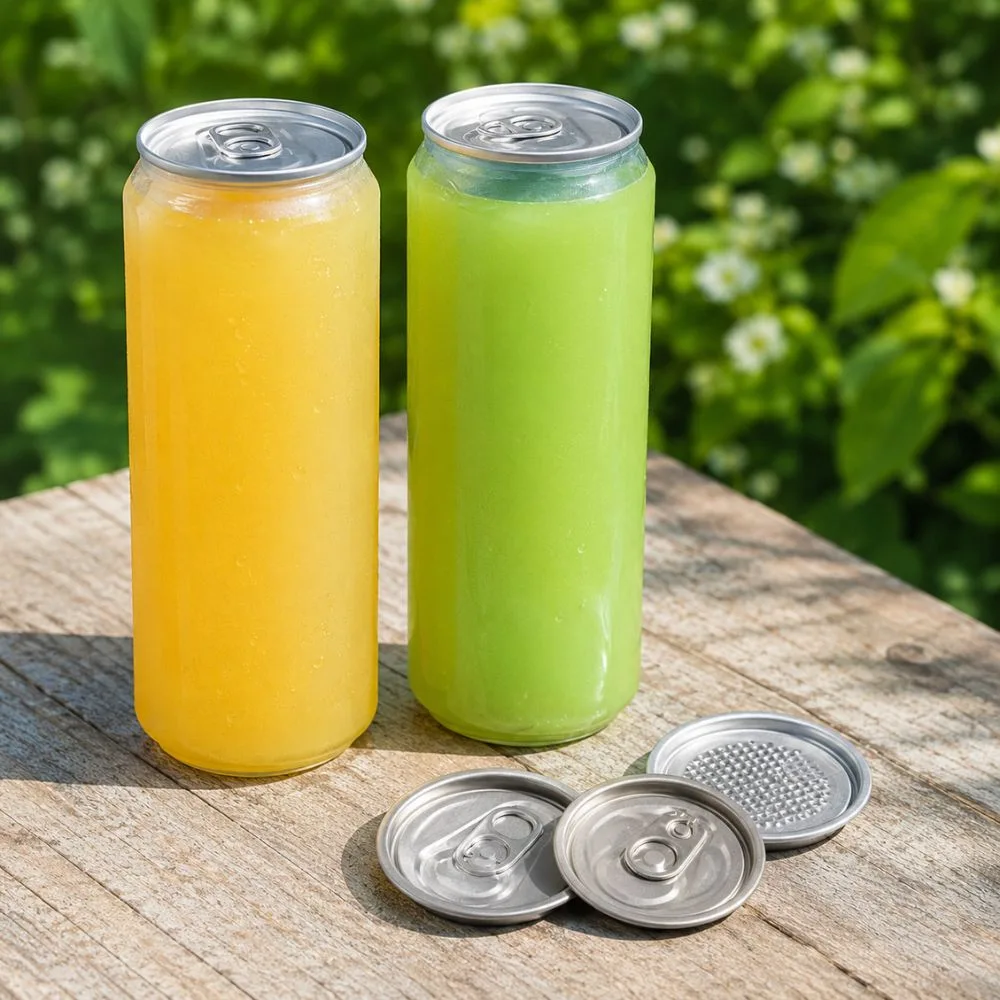
A PET can is a two-part set: a clear PET can body, blow-molded like a bottle, plus an aluminum ring-pull end, the same pull-tab lid you know from an aluminum soda can. The parts ship together but unsealed. After filling, a can seamer rolls the aluminum end onto the body rim, and the result opens exactly like a regular canned drink.
That hybrid is the whole point: the clarity of a PET bottle and the opening experience of a can in one package. Here is how it compares to its three closest alternatives:
| PET can | Aluminum can | PET bottle | Cup + lid | |
|---|---|---|---|---|
| Product visibility | Full, crystal clear | None | Full | Full (clear cups) |
| Seal | Seamed, tamper-evident | Seamed, tamper-evident | Screw cap, tamper band | Snap/press lid, not sealed |
| Resealable | No | No | Yes | Loosely |
| Filling | Cold fill only | Cold, hot, or retort | Cold fill only (standard PET) | Any, open pour |
| Equipment needed | Can seamer | Can seamer (high-speed lines) | Capper or hand-tighten | None |
| Realistic small-brand MOQ | From 5,000 | Typically far higher for printed runs | From 5,000 | Low |
The blunt verdict: choose a PET can when visibility plus a true seal matter more than resealability. If your customer needs to close the drink again, a PET juice bottle with a tamper-evident cap is the better tool: see our juice bottle size guide for that format.
Plastic drink can sizes: the full chart
The short answer: 8 stock volumes from 120ml to 650ml, and most programs are built on two or three of them. US-facing menus think in ounces, so the conversion is built in.
| Size (ml) | Size (oz) | Best for |
|---|---|---|
| 120ml | 4 oz | Espresso shots, tasting flights, samplers |
| 200ml | 6.8 oz | Kids’ drinks, minis, event pours |
| 250ml | 8.5 oz | Energy-drink format, small serves |
| 330ml | 11 oz | The classic international soda size |
| 350ml | 12 oz | Best-seller: the US 12 oz standard single serve |
| 450ml | 15 oz | Mid-size bubble tea, large juice |
| 500ml | 17 oz | Best-seller: bubble tea and fresh juice |
| 650ml | 22 oz | Large and sharing serves, oversized signature drinks |
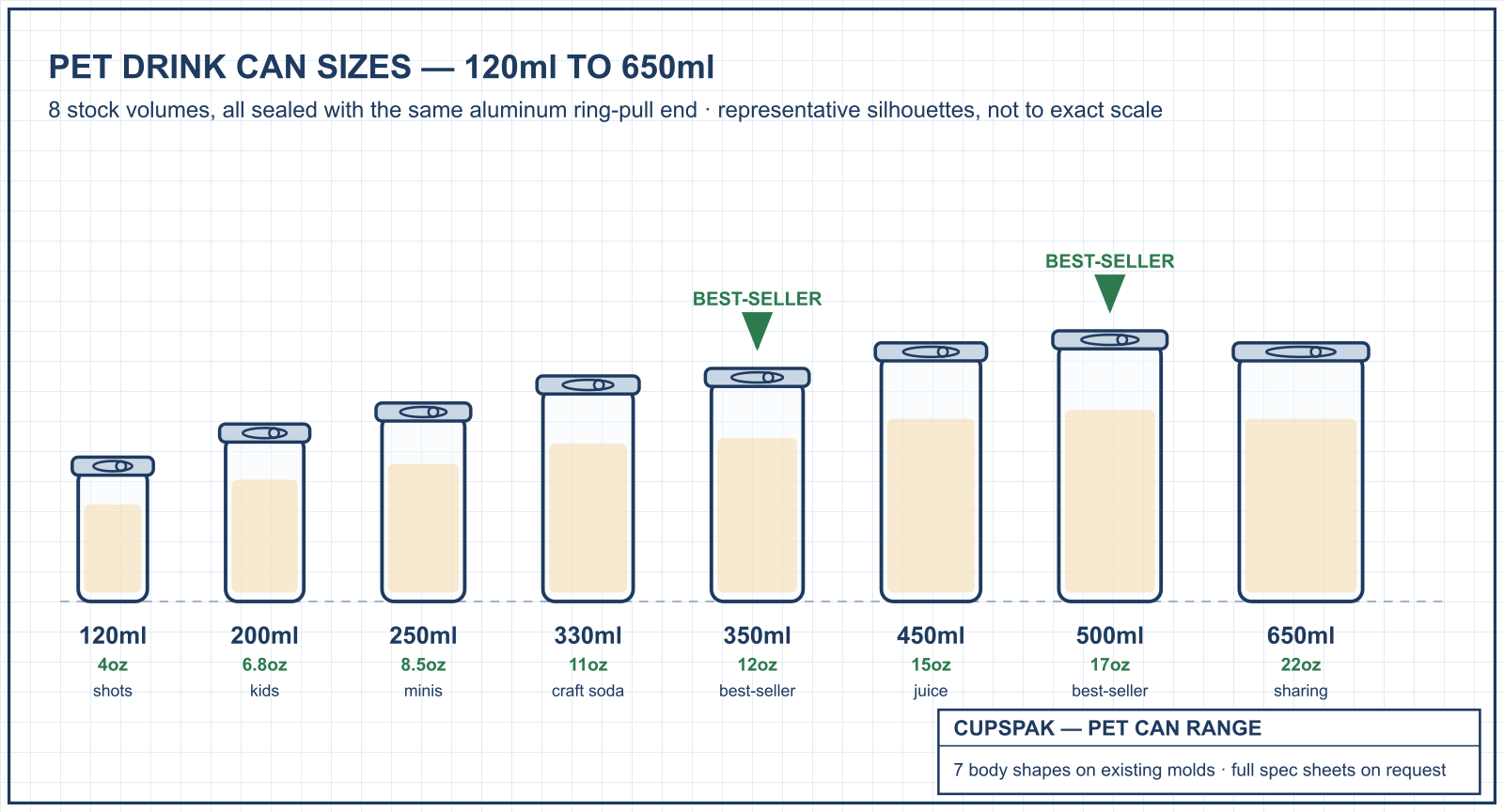
Three notes from across hundreds of client orders. First, most programs land on 350ml or 500ml: 350ml matches the single-serve soda habit, and 500ml matches the large-cup serve bubble tea and juice customers already expect, so the canned version slots straight into an existing menu. Second, the 120 to 250ml minis are quietly the fastest-growing tier: juice shots, kids’ drinks, and tasting flights all want a sealed small format. Third, height matters for coolers: 450 to 500ml bodies run 167 to 193mm tall depending on shape, while the 650ml stays around 168mm and grows wider instead. Measure your shelf clearance before you fall in love with a tall silhouette.
Which body shape should you pick? 7 stock options, no tooling fee
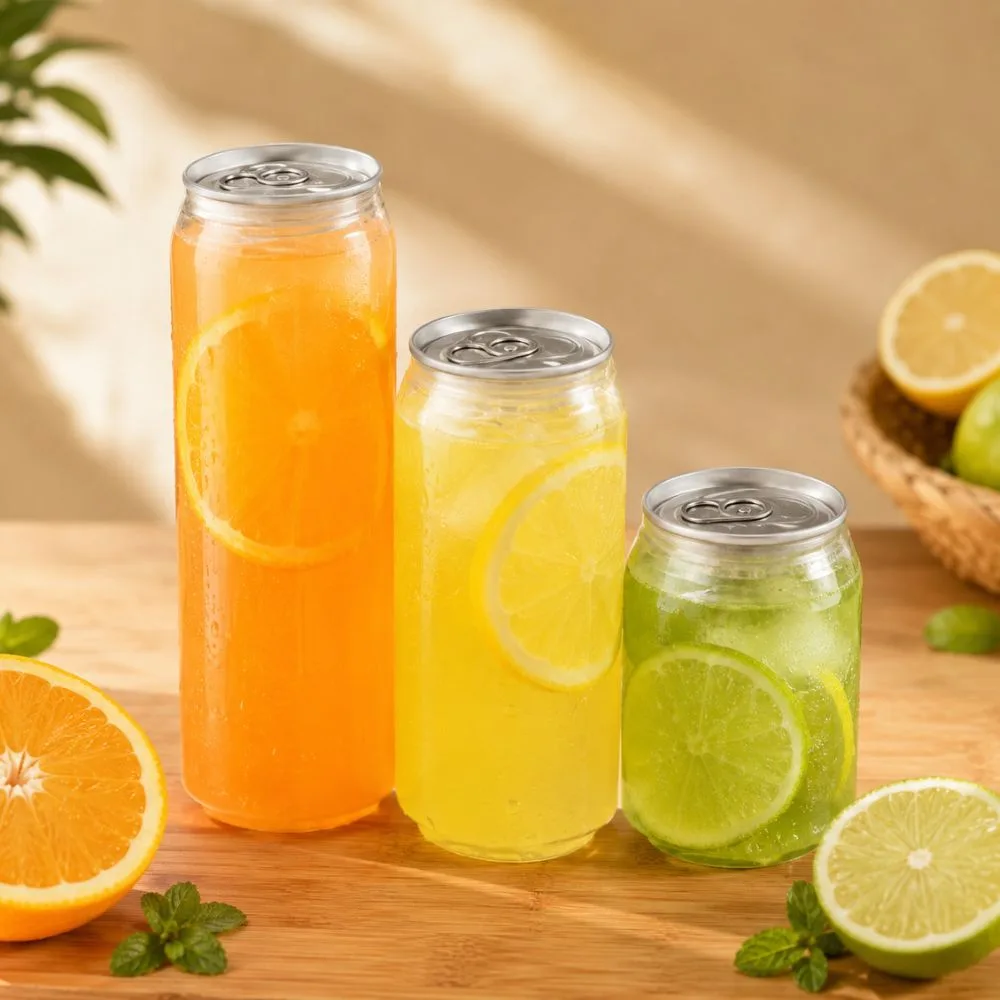
Most buyers assume a shaped can means custom tooling money. It doesn’t, not if you shape-shop from existing molds. The stock library covers seven body styles: straight, vase, square, faceted, hex-bottom, hepta-bottom, and plum-bottom, all with no tooling fee.
How to choose in practice:
- Straight: the default. Maximum label area, easiest to sleeve, stacks tightest.
- Vase: the bubble tea favorite. The curve reads premium in photos and sits naturally in the hand.
- Square and faceted: shelf-presence plays. Flat panels stand out in a cooler full of cylinders.
- Hex-bottom, hepta-bottom, plum-bottom: sculpted bases that add texture and grip without changing the silhouette above.
The insider note: a shaped can costs nothing extra in tooling, but it can cost you in labeling. Shrink sleeves handle curves; pressure-sensitive labels want a straight panel, so decide your decoration method and body shape together. A fully custom body beyond the stock library exists too, but it starts at 50,000 pieces: a scale decision, not a launch decision.
How do you seal a PET can? The seamer question
Here is the part of the plastic soda can format no size chart warns you about: the cans arrive as open bodies with the ring-pull ends packed separately, and sealing them is your job. The machine that does it is a can seamer, and without one you own 5,000 very pretty clear cylinders.
The good news: the machine is neither exotic nor factory-scale. A semi-automatic can seamer is a benchtop or floor-standing unit: you place the filled can, set the ring-pull end on top, and rollers curl the aluminum end and PET rim into an interlocked seam. Seaming takes seconds per can. One operator seals drinks as fast as most shops make them, which is why semi-automatic is the right scale for shops and small brands: fully automatic lines only pay off at bottling-plant volumes.
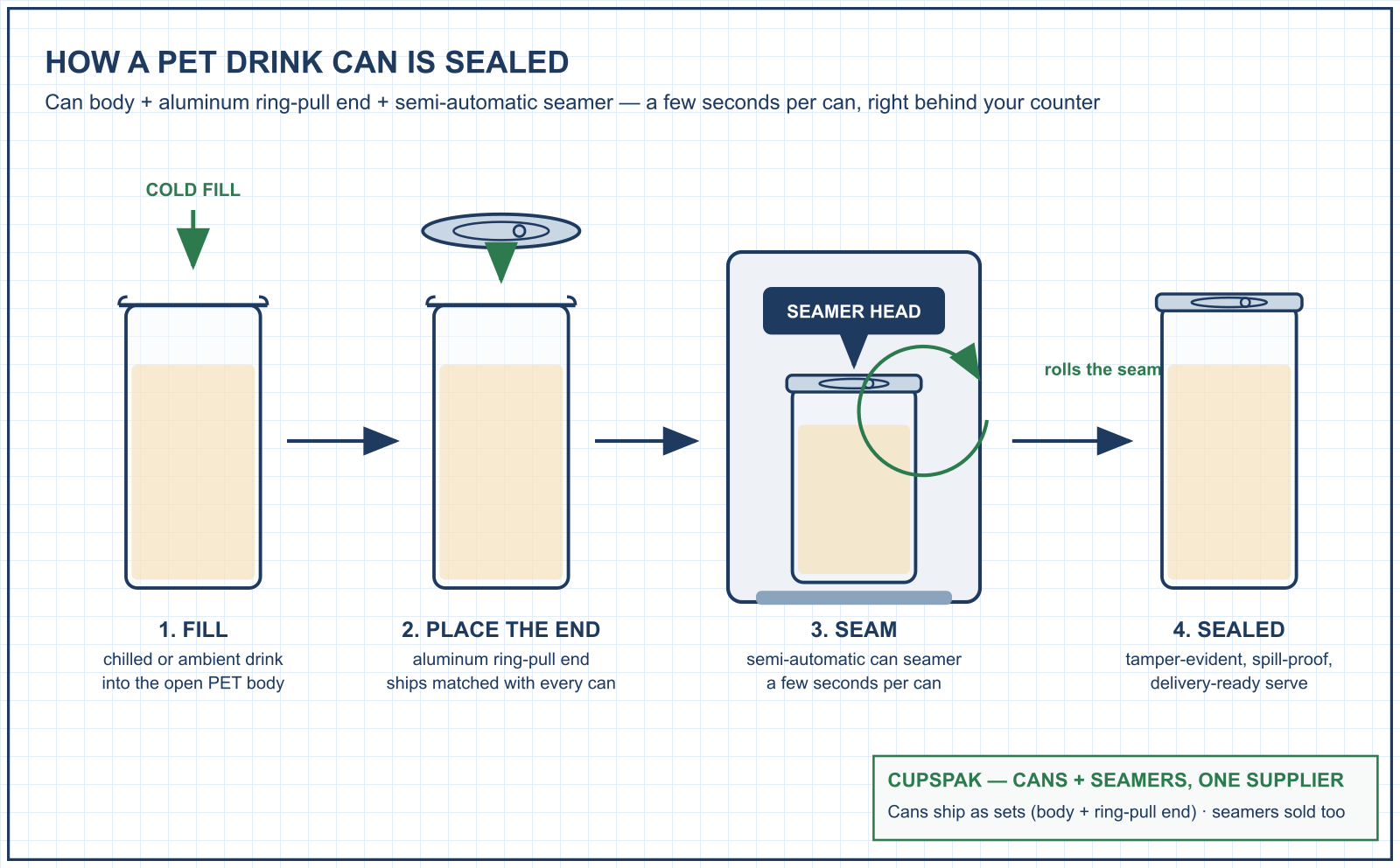
The canned bubble tea workflow in a real shop looks like this:
- Build the drink in the open can: pearls first, then tea, milk, ice.
- Place the ring-pull end on the rim.
- Seam it: a few seconds in the semi-automatic seamer.
- Hand it over or send it out: sealed, tamper-evident, and photogenic.
That is the entire process. No new counter layout, no specialist operator.
One sourcing note worth weighing: CupsPak sells both the cans and the semi-automatic can seamers to seal them. When cans and seamer come from two vendors, every seam problem turns into finger-pointing: the can supplier blames the machine settings, the machine supplier blames the can rim. One supplier for both means the seamer is matched to the can it will actually seal, and one contact owns any fit question. Ring-pull ends come in 3 stock styles, so you can vary the look without changing the seam spec.
Cold fill and summer freight: the honest limits
PET softens around 60°C, so these cans are strictly cold-fill. Drinks go in chilled or at room temperature, which is precisely how bubble tea, fresh juice, cold brew, and iced drinks are made anyway, so for most shop programs the limit costs you nothing. What it rules out is absolute: no hot filling, no pasteurizing the sealed can in hot water, no pouring anything steaming. If your process heats the liquid, cool it before filling, or read the “when not to choose PET” section below.
One more limit most suppliers never mention: summer ocean freight. A sealed container can run hotter inside than the weather around it, and on a small number of peak-summer shipments to hot-weather routes we have seen a few PET containers deform slightly, always in cartons stowed near the top of the container, where the heat concentrates. To be clear about scale: this has happened on two containers (Middle East and US routes), affected a small number of pieces in each, and has never occurred on cooler routes. It is rare, not normal, but if your order ships at the height of summer to a hot destination, tell us. Stowage position and shipment timing are easy to plan around when the risk is on the table, and it is exactly the kind of thing an honest quote should include.
Printing and branding: screen print or label?
You have two realistic decoration routes, and MOQ decides between them as much as design does.
- Screen printing, up to 3 colors, from 10,000 pieces. Ink goes directly on the can body: no label edge, no wrinkle risk, and the drink stays visible between print elements. Three colors is the ceiling, so design bold and simple: logo, one accent, one text color.
- Labels on clear cans, from 5,000 pieces. Order clear stock cans and apply your own labels or shrink sleeves locally. Lower entry MOQ, unlimited label colors, and you can change designs per flavor without reordering cans.
The practical pattern we see: shops and first-run brands start with clear cans plus labels at 5,000, prove the product, then graduate to screen print once a design settles. Clear-with-label also wins for bubble tea shops running rotating flavors: one can SKU, many label SKUs.
The cans are BPA-free, food-grade PET across the range, printed or plain.
When should you NOT choose PET cans?
An honest supplier tells you when their product is the wrong answer. Three cases where it is:
- Hot-fill products. Teas, coffees, or juices filled above 60°C will deform the can. Full stop. If your recipe demands hot filling, you need aluminum or glass.
- In-can pasteurization or retort. Shelf-stable programs that heat-treat the sealed package are aluminum-can and glass-jar territory. PET cans suit cold-chain products: made fresh, kept chilled, sold fast.
- Brands built on the aluminum recycling story. Aluminum’s infinite-recyclability narrative is real and marketable. PET is widely recyclable as #1 plastic, but if closed-loop recycling is the center of your brand pitch, aluminum tells that story better than clear plastic.
The blunt verdict: PET cans win for cold-chain, visual-first drinks made and sold fresh: bubble tea, juice, cold brew, smoothies. They lose on heat and recycling-story marketing. Pick your format for the product you actually make.
MOQ, samples, and how an order runs
The numbers to plan around:
- 5,000 pieces: MOQ for clear stock cans (with ring-pull ends), per size
- 10,000 pieces: MOQ for screen-printed cans, up to 3 colors
- 50,000 pieces: MOQ for a fully custom body shape beyond the 7 stock molds
- Free stock samples: you cover only shipping; order via the sample request page
- Semi-automatic can seamers: quoted alongside your cans, one supplier for both
Before any bulk order, put real samples through your real workflow: fill a can with your actual drink, seam it, shake it, chill it overnight, open it. Ten minutes of testing beats any spec sheet.
PET can spec checklist: copy this into your quote request
- Volume in ml (350ml and 500ml are the proven defaults)
- Body shape: straight, vase, square, faceted, hex-bottom, hepta-bottom, or plum-bottom
- Ring-pull end style (3 stock options)
- Decoration: clear (labels your side, 5,000 MOQ) or screen print ≤3 colors (10,000 MOQ)
- Seamer: do you need a semi-automatic can seamer quoted with the cans?
- Fill confirmation: cold fill only; flag anything filled warm
Frequently Asked Questions
Can you seal PET cans at home or without a machine?
No: a proper seam needs a can seamer; no hand tool or press-on shortcut produces a genuinely sealed, tamper-evident can. The realistic entry point is a semi-automatic can seamer: a compact unit that seals a can in seconds and is sized for shops and small brands, not factories. CupsPak supplies the seamers alongside the cans, so the machine is matched to the can rim it will seal.
What machine seals bubble tea cans?
A semi-automatic can seamer. You fill the can, place the aluminum ring-pull end on top, and the machine rolls the end onto the PET body in a few seconds. One operator keeps pace with normal shop output: this is standard equipment in canned bubble tea shops.
Are plastic soda cans recyclable?
The PET body is #1 (PET) plastic (the most widely accepted plastic in recycling streams worldwide) and the ring-pull end is aluminum. Whether local facilities process clear cans smoothly depends on your municipal stream, so check locally rather than printing a blanket claim on your label. Fair framing: widely recyclable, but not a closed-loop story: that narrative belongs to aluminum.
PET can vs aluminum can: which costs less for a small brand?
At small-brand volumes, the deciding cost is usually the minimum order, not the per-unit price. Clear PET cans start at 5,000 pieces and take locally applied labels, so you can launch without the far larger runs that printed aluminum cans typically demand, and without high-speed filling equipment, since a semi-automatic seamer handles the sealing. At national-brand volumes the math shifts and aluminum’s scale economics strengthen. Compare quotes at your real annual volume.
Can PET cans be hot filled or pasteurized?
No. PET softens around 60°C, so hot filling and in-can pasteurization will deform the can: a hard limit of the material, not a quality tier. Fill cold or ambient; if your process heat-treats the sealed package, choose aluminum or glass instead.
What is the MOQ for PET drink cans?
MOQ is 5,000 pieces per size for clear stock cans, 10,000 for screen-printed cans (up to 3 colors), and 50,000 for a fully custom body shape. Every can ships as a set with its aluminum ring-pull end, and free stock samples are available before you commit: you pay only shipping.
Ready to test the format? Browse the full range on the plastic soda cans page, then order free stock samples for your own fill-and-seam test, or send your size and quantity through the quote form and have pricing, seamer included if you need one, within 24 hours.
Ready to Source Eco-Friendly Paper Cups?
Request a free sample pack or get a wholesale quote tailored to your requirements.